Sunday, January 16, 2011

two words- Forged Composites

These sound soooooo amazingly sexy. The idea was prototyped and formed in a collaborative effort between Calloway Golf and Lamborghini in an effort to produce something that can solve some of the shortcomings of normal carbon fiber weaves. These problems include time for production, strength in directions not designed for, moldability, accuracy of molds, and the ability for bolts and non glue based bonding.

Forged composites solve these problems in the fact that the composite is not formed through the process of weaves of fabrics, but from the random array of carbon "chips", e.i., a small block of what is essentially a single direction of carbon. These chips resemble carbon scraps but are not random assortments of fibers. Instead they are pieces of uniform carbon that has been chopped and spread into many directions.

This array of random fibers solves the strength issue easily by making the random assortment average out into a piece that has relatively equal strength along its plane. This strength also allows bolts to hold pieces together without having to reinforce the marked holes prior to drilling. A rivet or threaded bolt can now effectively hold carbon pieces together.

The most amazing part of this setup is that a mixture of chips and resin can be inserted into a mold and heated to harden the mixture into an extremely accurate shape that can handle sharp corners and go from mold to finished piece in 5-6 minutes. Although the cost to produce is unchanged, the benefits of being able to mass produce cut costs of production and required labor immensely.

What makes this piece of technology so important is that it allows someone like you or me to still make complex, strong, and specially molded parts without the issues of bonding or making design decisions based on the ability of the carbon to make only a certain range of shapes.

Saturday, January 8, 2011

drills? say whattt

wow. its been a long time here. ok so the project is still going and ive found a 25$ drill in which i can basically screw up as much as I like.

ITs got a nice 18v battery and a nice switch from Radioshack which i can use without saudering it to the wires.

Thinking that a normal 18v motor outputs somewhere around 500 ft*lbs. of torque so it should be fine without needing to have a gearbox in between the motor and the, uhh, "drivechain" XD.

In this way i'll be able to drive the chain without needing anything complicated. I only need one gear in relation to the output and with the cheapest single speed bike this should be easy enough. A 0.5:1 ratio should be enough to drive the bike easily. It will undoubtedly need a kick off start but it should be strong enough.

Sunday, June 20, 2010

Next Project!

So hopefully his one will come through. I have a good friend going to UCSB in the college of creative studies (the nerds among parties) and we feel like trying to make a cheap ass electricly assisted bike. This means cheap motor and parts just to keep the bike going with no pedaling and to make hills much much easier since you have a motor helping you pedal along.

So ideas anyone?
right now I'm thinking this for a simple and cheap start. We will be using power tools with those interchangeable rechargeable batteries. That way we can make a sort of pack of 3 or 4 batteries or just 1-2 that can be taken off the bike so they don't get stolen and he can take it and just sit it by an outlet to charge.

The motors on some of these tools are quite strong. Though not enough to accelerate or to go alone like a scooter, but enough to pull along nicely once you get moving.

Saturday, February 13, 2010

Weaves and the many annoying funky types


So.... first off, why are there weaves and why so many weaves of CF. The simplest reason for most is that different weaves can either give varying amounts of strength and looks. they distribute forces in multiple directions differently and can often change strength in the way they are laid and molded as just for a different weave.

So lets just get into this and look at the first few weaves and the one's I have used. For a quick reference without looking at any data sheets (which I always recommend for the serious man), look at the pattern and see how many fibers go in each direction to determine the strength in that direction.

Also, you'll often notice something in the weave called 3k or 6k. This is essentially the fiber density per strand. higher density= stronger, but also heavier in a pretty direct proportion.

Plain Weave: which is just that, plain. If you've ever tried to make a simple piece of fabric or cloth, you've made this pattern. You can see it to the left. Like its right there and pretty big (its even 12k density to really show off, and a watermark cause I can't find a pic of my own to show the pattern well). Like seriously, if you can't make out this pattern then just stop. The over-under pattern is the most basic there is. This is pretty standard and works fine. Not the strongest of weaves but is solid and shouldn't let down. What I do love about this weave though is that it is the easiest to handle without making the fibers on the ends too messed up. Other weaves fall part incredibly fast, but make up for this is some cool patterns and more strength in the direction of the weave.

Now: the cooler looking one and still easy to handle(though not as much).
2x2 Twill weave
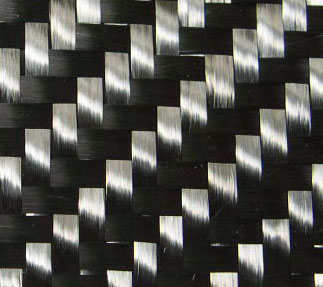
Now, as you can see, the pattern is over-over- under-under. Yet the amount of fibers in one direction is still equal. No real strength gain over Plain, but it gains a benefit for being cooler looking and easier to bend and mold into sharper corners. this is often the cosmetic choice for its unique look compared so as to stand out a bit more. Tell me if you have any more experience with this cloth being stronger than plain. I've used both of these weaves and noticed nothing than cosmetic and ease of molding differences.


the funky, exotic, smexy, and odd weaves.
Now there are TONS of weaves, wayyyyyyy too many for this one post, but I'll go over 3 more. I have little to no experience with these so tell me what you think of these in the comments.

Satin Weaves (#HS)

These are supposedly some of the stronger structural weaves as far as I know. It is also pretty plain to see that the weave will fall apart in your hands if not handled well. Looks pretty cool though huh? for reference, the standards are 5HS and 8HS, the number denotes how many times a thread goes over the filler and then once over (5HS= 5 over 1 under 5 over, etc.)


Unidirectional
Ok, this apparently offers the Most strength in one direction, hence the name. Use this in applications where almost all of the forces exerted on the object come form one axis (up and down, left and right, front and rear). You can often buy this as a Tape of some sorts, even pre-peg (glue already in) to make a simple reinforcing sheet to a dent or so for repairs if not an entire weave.
I don't like the look personally, but I'd like to see it executed well. Also, you see that weave perpendicular to the direction? This is probably Carbon Fiber, but some can even be made of fiberglass since it really doesn't add much strength. Again, I have no experience with this weave. sorry guys. not rich enough to play with everything, Yet!


Funky one
This is a twill weave, but instead of Pure Carbon, Kevlar is mixed in. It's supposed to be Impact resistant (huh, carbon already is for the most part). But Kevlar was often used as the light space age composite of choice before carbon Fiber. I can't remember (and Wikipedia isn't helpful today), but Kevlar has one of the best yield strengths (like 3600 MPa, that's 3600 million Newtons per square Meter if my Metric is right. Wiki says 3620 MPa).


Now for some cool colored Weaves for that finishing touch.

Blue Kevlar Weave-------->


<-Holographic Weaves

Friday, February 12, 2010

What is a composite (i.e. Carbon fiber)?

There's a lot of weird thoughts about what a composite is. The most commonly know composite is Carbon Fiber and it has a whole ton of weird thoughts and expectations from people. Not only that, but people who have tried to make a composite may get dwarfed by all the new things and materials they have to use. Yet, all in all, composite construction is actually a very easy task anyone can do, albeit time consuming.

So lets start with a composite:
http://en.wikipedia.org/wiki/Composite_material
wow, look, done! This article is actually pretty good but leaves a bit to be desired when put to practical use. So for now I'll give a brief overview.

A composite is essentially just a fibrous material in sheets that are laid over each other in some sort of pattern. Ply wood is probably the oldest and a very good composite. If you look at its side you can tell its a composite because you can see the layers of wood inside laid so that the fibers of the wood are all perpendicular to each other ( or as close a 90 angle as possible). The strength of composite materials lies largely in these patterns and how the fibers are bonded together to make a solid piece.

Now I'll make a much more detailed post later (since I like pictures) of how this is achieved.

So lets talk about some basic composites:

Plywood(PW): a good start that many people are familiar with. Its strong, light for its strength compared to other solid woods, and in this case, pretty cheap. its made from thin sheets of wood that are then placed so the fibers criss-cross. now a note: all these fibers are grouped in planes (one sheet has all fibers in one direction) which is quite different from other composites.

Fiberglass(FG): this is another nice composite. Its cheap and lightweight so you can quickly build up a nice strong piece. It is weaker than many composites, but a good epoxy (more on that later) will make it many times a good solid choice. It is made of tiny fiberglass strands woven together much like a piece of fabric. The only difference is that each weave is composed of large "bundles" of strands. there are many, many other ways of weaving fiberglass for its many different purposes. Its easy to mold in many cases and can be used for tons of fun things. I recommend it as long as you aren't demanding high strength.

basic fiberglass can be seen to the Left.


Carbon Fiber (CF): The crazy one. This is for basic carbon fiber as there are enough variations to make you go nuts. http://compositeenvisions.com/. look at this, so many freaking weird cloths and uses. Now, there is a whole way to make it look sexy like that (and most people can't tell its CF when it isn't shiny), but I will start with the basics. So for starts, this is almost exactly like FG in its from, but the main difference is that the strands are now Carbon instead of some silicate (glass). This allows for a much better strength-to-weight ratio over fiberglass.

Now notice, fiberglass per volume is lighter than CF, but is weaker per volume than CF so much so that for the same strength, less mass of Cf can be used. Yet it will still probably cost more.


The site I showed you looks a bit expensive but not too bad, but just remember to look at how much you are buying.

Now, next time I'll go into the many types of weaves and how crazy they are.

Woah look! A big fat Blog!

Hey guys!

I've made this blog to start talking about and recording my various work on my team's TARC (Team America Rocket Challenge) project as well as other little things i find here and there. This blog will probably focus mostly on engineering projects that i've been working on and I'd like to try and fit in a CAD viewer so y'all can see some of the models I make. Updates will not always be constant, but as time goes on i'll keep on adding.

So, now, onto composite construction!!!